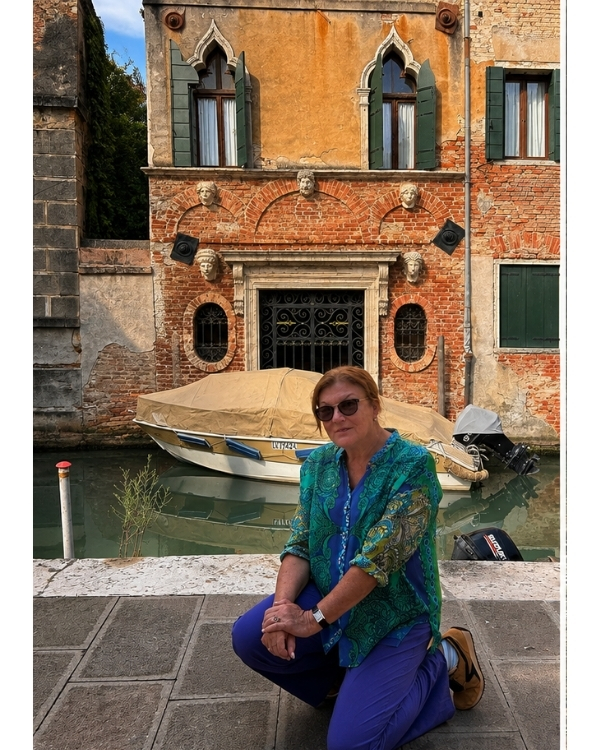
Trying to be practical this time, I chose Cinque Teste in Venice mainly for its proximity to the train station. Of course, the celebrated Venetian garden right on the property sealed the deal when I booked a room.
Getting to Cinque Teste and getting lost.
Supposedly, it would only take ten minutes from the train station to get there, which meant a pleasant walk and no porter. I forgot that Venice, unlike other Italian cities, hides its thorns behind the beauty, as nothing there is as it seems. You get easily lost, and ten minutes walking can turn into hours climbing up and down the cobble bridges over the canal.
My twenty-six-inch suitcase on a hot September day felt like a small house on wheels. After dragging it up and down several small bridges, every bridge felt like a mountain climb.
When the GPS showed that we were only 150 feet away, the “You are here” mark appeared. Here? Where?
Of course, every person was pointing in the opposite direction. Even charming delivery guys looked less than certain. The whole ordeal took about an hour of wheeling, climbing, and entering almost the right courtyards.
Finally getting there
Completely defeated by the heat, I finally called Luana, the owner of Cinque Teste. She tried to explain, but my brain was too foggy to understand. So she came out for the rescue. While she exuded polite authority, I was an angry mess of a woman. When I finally saw her slender, confident form approaching, I wiped the sweat from my face with the flat of my dirty hand. My hair felt sticky, and my previously white T-shirt turned into a wrinkled disaster. Meanwhile, she smiled and touched her perfectly styled curl. “You should have hired a porter!”
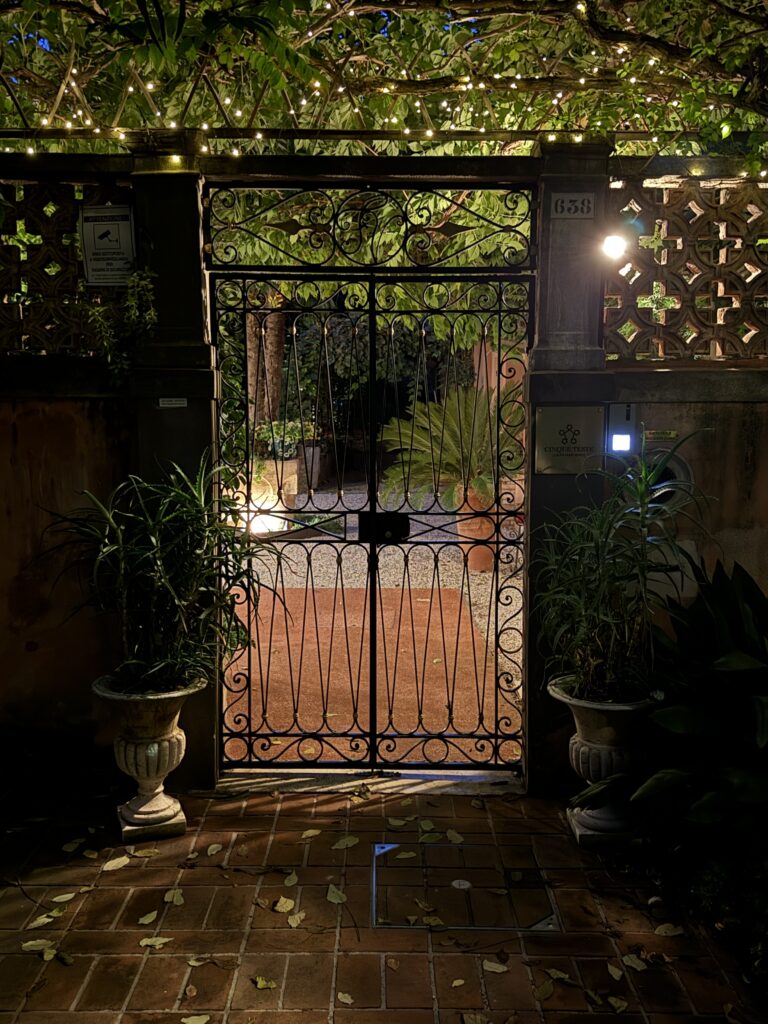

We walked together in silence; no house matching the photo of Cinque Teste on my phone was in plain view. Then we turned yet another corner where the spectacular entrance gate finally appeared.
I felt like I entered a portal to a dream.
The Garden
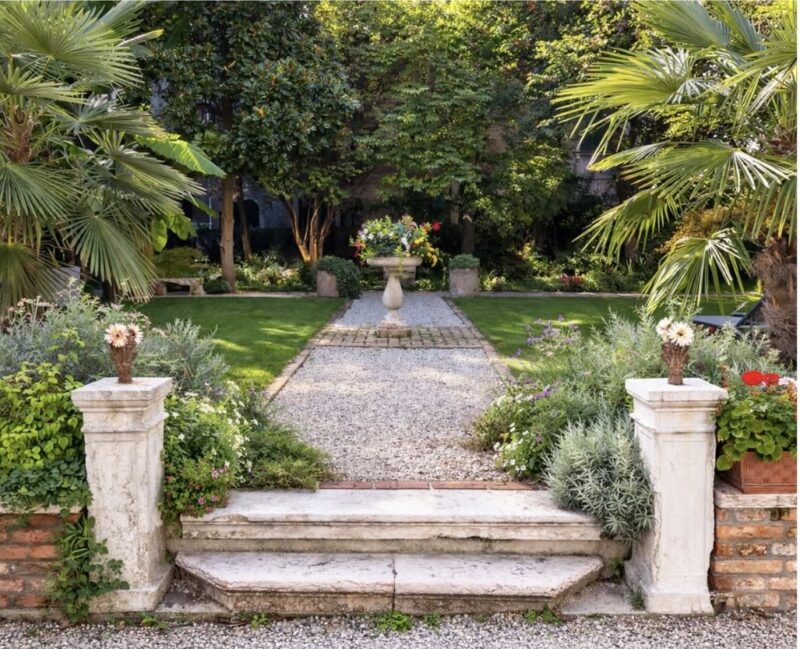
The gate opened onto a splendid garden, a giant park by Venetian standards. Flowers, trees, and cascading grapevines hugged the ancient stone walls. The shadows of the leaves, the whisper of the breeze against my face, and the peacefulness of the place made me forget all my troubles.

Gently, Luana offered a glass of icy cold water. As I drank it, I found myself wondering how they managed to keep a garden this lush in Venice, where fresh water itself feels precious. Then I spotted some loungers and an elegant cafe patio- all I needed to relax after a long trip.
A lazy-looking furry princess narrowed her eyes in disapproval when our luggage rattled along the ancient pathway toward the main house. Perhaps he was offended that the beautiful marble staircase was used for our overweight luggage. The hallway of the second floor looked promising. The Murano glass chandeliers mounted directly on the exposed beams and the artwork on the walls were enough to spark curiosity.
Our room in Cinque Teste, Venice

Our room was on the second floor overlooking the canal. As we walked in, the two large Venetian windows welcomed us with all their glory. The original Venetian Gothic windows with playful flame-like tops were exquisite. At first, I even hesitated to open them. But then I did. After all, they witnessed hundreds of years of human touch; perhaps they will survive my hands as well. Joy and sorrow, decay and revival – they were there in their silent presence as if asking us to pause, look out, and finally notice the ancient Venetian panorama.
The view from the window was exactly what I hoped to see in Venice. The lights reflected in the canal, a seagull perched on a cosy balcony, and the perspective of the ancient architecture did not disappoint.

If all you see is the bed first, then it turns into an ordinary hotel room; turn around, and suddenly—those windows. That floor. Venice.
The furniture acted as a capable supporting actor while the windows took center stage. And of course, all of this is sitting on a terrazzo floor beneath those Gothic/Venetian windows, which makes the room especially interesting.
Most of the pieces had simple lines and light wood finishes, which are common for midcentury Italian style. However, a few pieces cleverly referred to older Venetian classics. What was refreshing was that, instead of using predictable dark wood furniture, the pale midcentury pieces made the room feel lighter, easier, less precious. Easy, rectilinear forms, almost no ornament, and simple open compartments were effortless and comfortable.
Also, you could actually let your child use all of it without a frantic Don’t touch or else!
And of course, all of that furniture was sitting on a terrazzo floor beneath those Venetian Gothic windows!

The bathroom held a lovely old mirror that had survived Venice’s floods.
I was wondering,
Who used this mirror a hundred or two hundred years ago?
Common areas

The downstairs, as well as the rooms and the garden, are calling for a closer look. At first sight, the common areas were what you expect from any hotel – a breakfast room, a reception area, a sitting area. But then, after a delicious coffee and a freshly made breakfast, you linger and notice how the faceted mirror plays with the objects around it, and how the iconic Venetian light reflects in the small mirrors and glass.
Art. Gennaro Condurso

Like a whimsical potpourri, the clay masks and objects by Gennaro Condurso are everywhere within the house and the garden. They are in the guest room, by the doors, in common areas, and in the garden. The pieces feel ancient even though they are contemporary. But you also sense that the art is not there just as decoration. They make you wonder about their hidden meaning. Nothing is as simple as it looks in this house.
And of course, Luana has stories to tell about Condurso’s work.
Condurso draws on ancient Mediterranean rituals, folk beliefs, and protective symbols traditionally intended to ward off evil. His pieces reinterpret those old forms as contemporary art. Once you know this, the strange faces scattered throughout Cinque Teste no longer feel merely decorative. They seem to be watching over the house and its guests.
The people of the house

The owners and staff are remarkably approachable. Norberto likes to talk about the garden. You can spot him looking elegant even while trimming the bushes. While I wear off-white to special occasions, he wears the same kind of pants to work.
It seems that there is always friendly chatter in the library and outside.
I recall a very meaningful conversation with Luana that started with a simple compliment. Then, casually, I asked about the house renovation and the choice of materials. At that moment, she was working by the reception area, as always. And yet, she stopped whatever she was doing and reached for a thick book of photos related to the recent renovation disaster. I didn’t know much about it. She shared that it took thirty months to restore. Then the house was flooded right after the last nail went into the wall. To make it even more devastating, COVID hit right after, and the whole world was shut down. No guests. No money, no business.
And yet, they survived. They breathed new life into Cinque Teste guarding the ancient beauty like a mother guards her baby!
Needless to say, I looked at the house now with completely different eyes:
Centuries pass, tragedies happen, but beauty is one of the things worth saving. We, humans, can’t be happy without beauty.
And here is the paradox: We cross the oceans to see the ancient cultures, and yet take no time or effort to learn how to navigate in a fragile old world, and how complex it can turn out to be.
If it is something that we crave so much, should we give it more time, patience, and care?
I started my trip to Venice stepping over the bridges with a heavy suitcase in search of inspiration. Perhaps I should have been less arrogant and more realistic. Then I took my time to touch upon many things that only become clear after you make an effort to understand them.
Cinque Teste, with its impossibly charming garden and wonderful secrets, became my silent friend—a place I want to return to years from now and find still there.

.
Tense mismatch:

Leave a Reply